when your job IS your identity
Over the last couple of weeks, I have had the opportunity to speak with a number of public servants. Friends, former colleagues, clients.
For some, there is a sense of angst as they wait for the release of details from the Comprehensive Expenditure Review. Will they receive a letter indicating that their job is one of thousands that will be 'affected'?
For others, those who may have received a letter that they were eligible for the early retirement initiative, their apprehension lies in knowing whether they will actually be entitled to access the incentive.
It is a time of great uncertainty for many right now.
In my own transition out of the public service, and the work that I have done as a coach since I have left, I have spent a lot of time thinking about identity. Particularly identity as it relates to our career. It is a topic that I LOVE. I talk about it a lot in coaching, I cover it in my Art of Leaving workshop and I am working on a tool /exercise on identity for my coaching practice right now.
I think it is because for me, so much of my identity used to be wrapped up in my career. Public servant. Executive. Leader. Much of my adult life, I focused, no, invested, most of my time and energy in my career. I did not stop to think about my own values. As a public servant, the values of the public service—Respect for Democracy, People, Integrity, Stewardship, and Excellence—were so ingrained in me that it did not occur to me that I would have my own.
As I reflect back, with more grace, it is easy to see how I lost myself in my career. My identity wasn't just wrapped up in my work, it was my work. If you know my story, you know that it was the very realization that work was getting the best version of me that sent me over the edge into burnout in 2022.
Since I have left Government, I have worked really hard not to let myself be defined by my career. Recognizing that I carry many identities—mother, wife, daughter, sister, friend, entrepreneur, coach, employee, leader—I have spent a lot of time working to develop a more solid sense of who I am. It is very much a work in progress. In fact, just last week I had a discussion with my therapist about how challenging it has been for me to define my identity outside all of my roles.
And then, like some kind of magic, I listened to a podcast my friend had sent me a week earlier, with a note that it had made her think of me. She has been a bit of a kindred spirit for me. We have many things in common: parenting, grief, a deep desire to see more empathy in the world. When she sends me something, I know it's going to be good. Plus it was The Good Inside with Dr. Becky Kennedy, who teaches me something every time I listen to her.
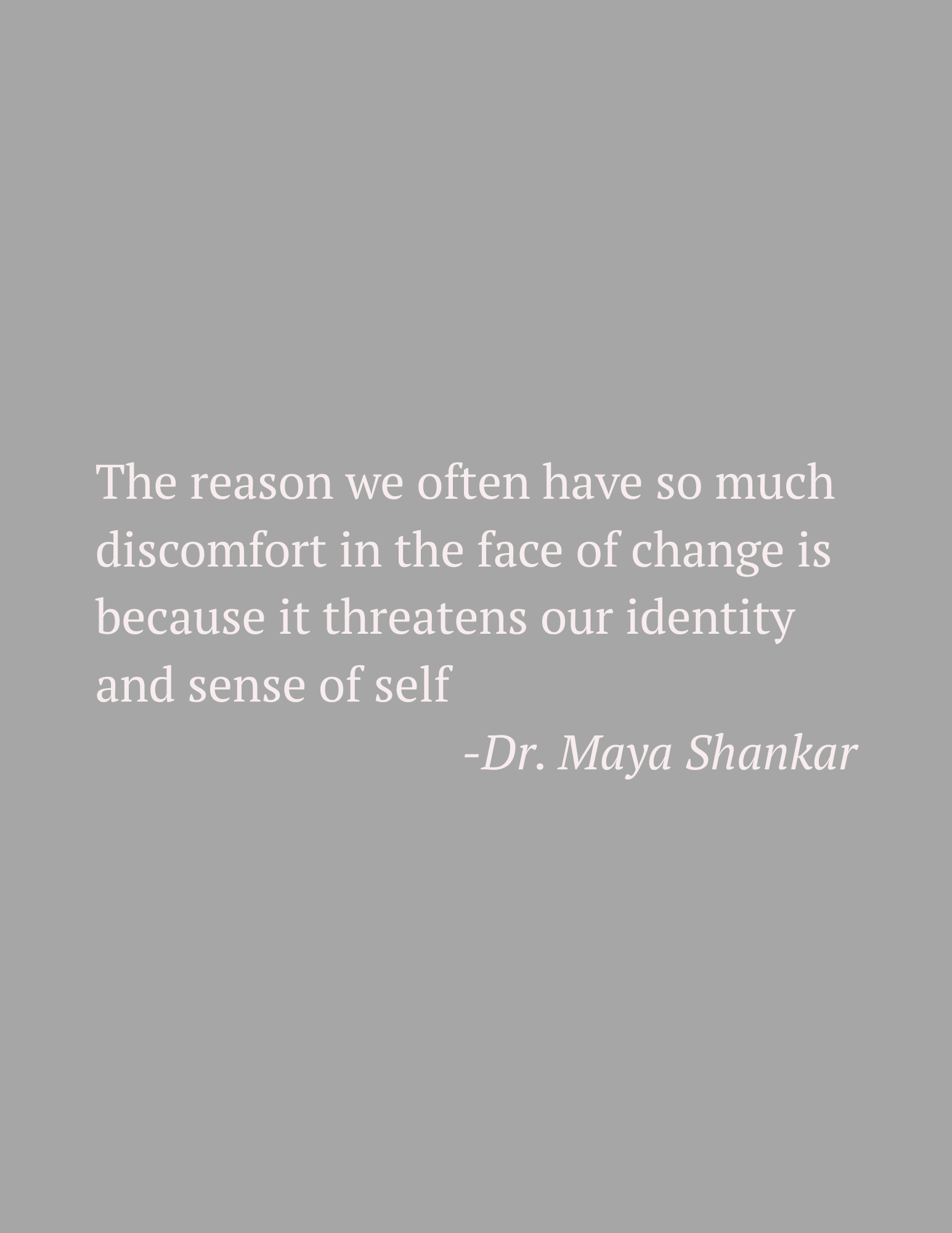
I had no idea that this podcast was exactly what I had been missing in my identity definition crisis. The guest was the brilliant Maya Shankar, a Cognitive Scientist. She was discussing her book, The Other Side of Change, which comes out tomorrow.
It felt like almost immediately, Shankar started to talk about identity. She described exactly how I felt when I left Government: when our identity is defined simply by what we do, transitions become very difficult. Shankar offered an alternative. When we shift this thinking to why we do what we do, it can help us find our moorings in turbulent waters.
In the context of your career, she suggested focusing on questions that tackle your why to figure out what about your career matters to you. Questions like: What is your motivation to go to work every day? Or what about your career really lights you up? Starting to answer some of these questions can help you brainstorm other outlets to satisfy this why outside of your career.
To emphasize her point, Shankar shared a story about her friend Michelle. Michelle's mother was battling a serious illness and grieving the fact that she could no longer make meals for her daughter. Michelle, who was familiar with Shankar's work, worked with her mom to understand what she was getting from cooking these meals. The answer? Feeling like there were so few opportunities to take care of her daughter now that she was an adult, cooking meals felt like a way that Michelle's mother could show her love. Now that they had this information, they were able to work together to find a different solution within her mother's current physical capabilities.
This story shows what happens when we dig beneath the what to find the why. It exemplified the precarious nature of tying our identity too tightly to something that can change, because when that change inevitably comes, we can end up feeling completely untethered.
For me, working to discover my why has been transformative. I realized that what I loved most about my public service career wasn't the title or the position—it was the opportunity to work on programs that served Canadians who needed support the most, to navigate complex challenges alongside talented teams, and to help bring clarity to difficult policy questions. Understanding this has allowed me to continue living that purpose in different ways, even as my career has changed.
If you're facing uncertainty right now—whether it's waiting for news about your position or contemplating what comes next—I encourage you to start exploring your why. Not because it makes the uncertainty disappear, but because it gives you something solid to hold onto when everything else feels uncertain. It reminds you that who you are is so much bigger than what you do.
And if you're navigating this transition, don't go through it alone. These moments can feel isolating, but they don't have to be. Find your people. Whether it's a conversation with a friend, coffee with a colleague, or working with a coach—connecting with someone you can talk to, someone who understands what it feels like to rebuild your identity outside of your role, can make all the difference. If that person is me, I'm here.